The Noise Behind the Numbers
When modeling brand metrics such as awareness, consideration, preference, or recommendation, most practitioners run into the same problem almost immediately: the data is noisy.
And that’s completely normal.
Brand data typically comes from surveys. Survey methodologies change. Sample sizes fluctuate. Respondent composition varies from wave to wave. And then there’s the most unpredictable variable of all: people.
Ask the same person the same question twice, and there’s no guarantee you’ll receive exactly the same answer. Human attitudes are not perfectly stable, and measurement itself introduces uncertainty.
The core issue is that a weekly brand tracker is a sample estimate, not a census. If a wave interviews a few hundred people, the sampling error alone can easily be 2-5 percentage points, which is often larger than the week-to-week movement you actually care about.
Yet despite this reality, a common practice has emerged across the industry: smooth the brand metric before modeling it. Most often, this means replacing the original KPI with a moving average and using the smoothed version as the target variable in the model.
At first glance, this seems reasonable. The series looks cleaner. The trends become more visible. The model fit improves. But there is a fundamental problem.
The Dangerous Assumption Behind Smoothing
When you smooth a media variable, you’re reducing noise in an input.
When you smooth your KPI, you’re modifying the very thing you’re trying to explain. In other words, you’re no longer modeling reality. You’re modeling your interpretation of reality.
By applying a moving average to consideration, awareness, or recommendation, you’re making an implicit claim:
“I know which observations are noise and which observations represent the truth.”
The problem is that you don’t. Nobody does.
The purpose of modeling should be to learn from the data, not to overwrite it with our own assumptions before the analysis even begins.
The Real Reason People Smooth Brand Metrics
Most practitioners don’t smooth brand KPIs because there’s a strong theoretical justification. They do it because they’re uncomfortable with uncertainty.
And because they want a higher R². But the industry itself is partly responsible for that mindset.
Let’s be honest: a noisy KPI is difficult to explain.
The noisier the dependent variable, the lower the achievable model fit. That’s simply mathematics. R² measures the proportion of variance in the KPI that the model can explain. If part of that variance is nothing more than sampling noise from a weekly survey of a few hundred respondents, then that variance is, by definition, unexplainable.
No model, regardless of sophistication, can predict whether random survey noise will push this week’s result slightly up or slightly down. Media spend didn’t cause it. Pricing didn’t cause it. Competitor activity didn’t cause it. It’s simply noise.
This creates a temptation. Analysts can either accept the uncertainty and live with a lower R², or smooth the KPI and report a much more impressive model fit.
Too often, the second option wins.
The Modeling Tools Encourage This Behavior
Part of the reason is methodological. Most MMMs today are built using off-the-shelf packages such as Robyn, LightweightMMM, a standard regression in R or Python, or even Excel Solver. These approaches typically estimate adstock and saturation effects through curve fitting, optimization routines, or evolutionary search algorithms rather than through a fully Bayesian state-space framework.
There is nothing inherently wrong with these approaches. They have made MMM more accessible and brought rigorous measurement to a wider audience. However, they generally treat the KPI as if it were observed without error.
For many marketing KPIs this may be a reasonable approximation. For survey-based brand metrics, it often is not.
As a result, every fluctuation in the brand metric becomes something the model attempts to explain rather than something it recognizes as potential measurement uncertainty. The natural response is therefore to smooth the KPI before modeling.
A smoother KPI is easier to fit. It produces a higher R² and creates the impression of a more reliable model. But that improvement is often illusory. The model hasn’t necessarily become better at explaining brand dynamics. We’ve simply made the brand easier to explain.
Why High R² Can Be Misleading
A high R² is often interpreted as proof that a model is good. But when it comes to brand metrics, this can be highly misleading.
Take brand consideration. Most marketers would agree that consideration is a relatively slow-moving concept. People’s attitudes toward brands do not usually change dramatically from one week to the next.
If one measurement reports 40% consideration and the next reports 90%, our first reaction is probably not:
“The brand became twice as strong overnight.”
A much more reasonable explanation is measurement noise.
Of course, exceptions exist. A major product launch, a corporate crisis, a viral event, or another significant external factor could genuinely shift brand perceptions. But if the underlying phenomenon has truly changed, we would expect subsequent measurements to reflect that new reality.
The challenge is separating genuine signal from measurement error.
Smoothing appears to solve this problem, but only by making the data conform to our expectations. The resulting R² may look impressive, but it often tells us more about the smoothing process than about the model’s ability to explain real, media-driven movement.
Uncertainty Is Not a Bug. It’s Part of the Data.
The better approach is surprisingly simple: Accept that uncertainty exists.
Brand metrics are not precise measurements like temperature readings from a calibrated sensor. They are estimates derived from samples of human opinions.
Every survey wave contains uncertainty.
Every observation contains uncertainty.
Every KPI contains uncertainty.
Instead of pretending that a survey result is the exact truth, we should acknowledge that every observation is merely an estimate of an underlying brand state that we can never observe directly.
This mindset fundamentally changes how we evaluate models.
Rather than expecting the model to explain every wiggle in the data, we ask whether it can identify the underlying movements that persist beyond measurement noise.
That’s where the real value lies.
What an Unsmoothed Brand Model Actually Looks Like
Many practitioners would look at the following model fit and immediately conclude that the KPI is “too noisy.”
That’s exactly the point.
The chart below shows an MMM fitted on unsmoothed brand preference data. No moving averages were applied to the KPI. The model sees exactly the same data that was observed in the survey.
The data is simulated, so for once we know the truth. A latent weekly brand preference of around 2% is driven by TV flights, always-on online video, seasonality, and slow brand drift. Each week a survey of 120 to 200 respondents measures it with ordinary sampling error. A Bayesian state-space model then sees only the survey results and the media plan.
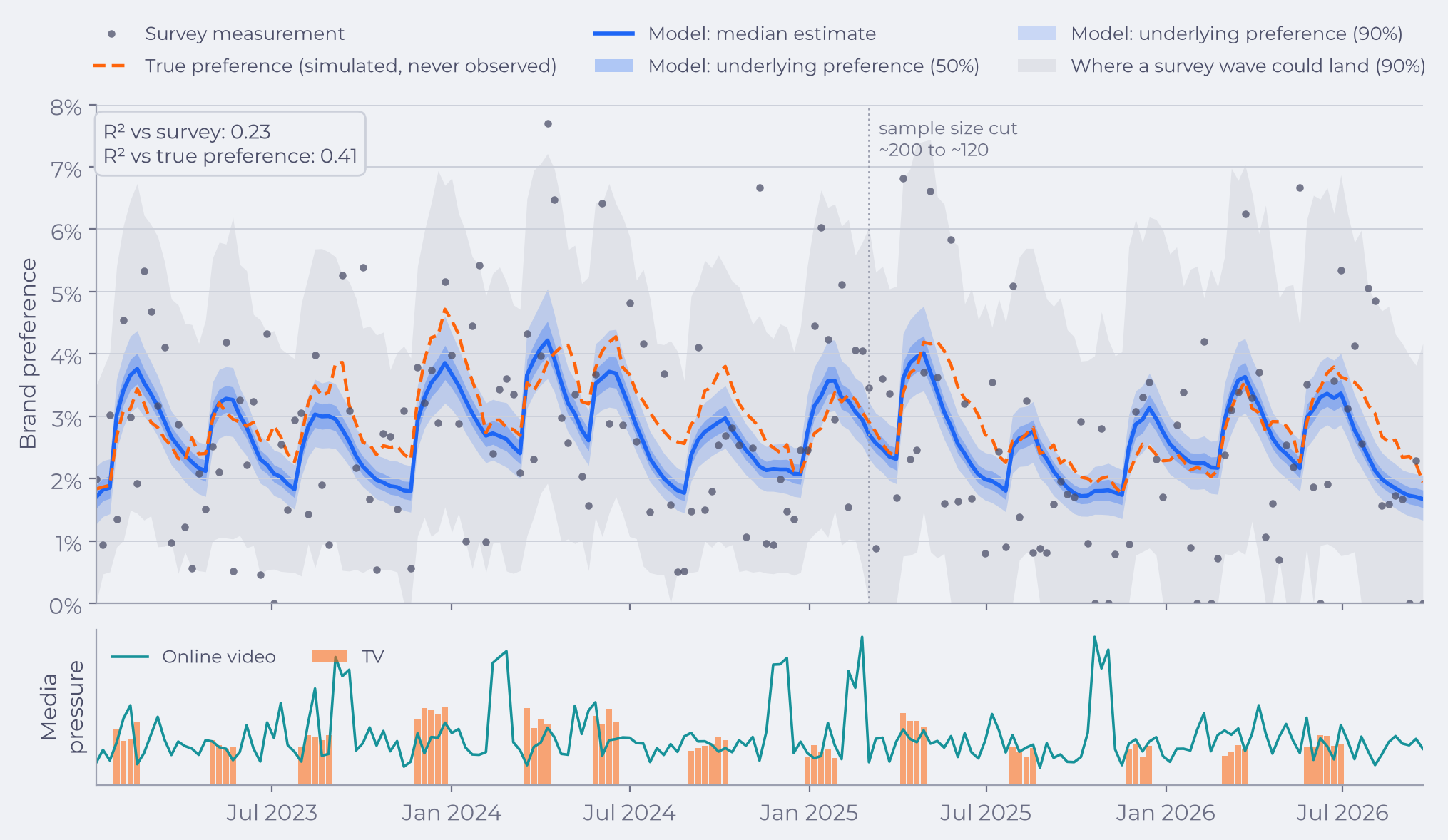
At first glance, the uncertainty band may look wide compared to what we’re used to seeing in traditional brand models. But that uncertainty is not a weakness. It’s an honest representation of reality.
Survey-based brand metrics contain substantial measurement uncertainty. Pretending that uncertainty doesn’t exist by smoothing the KPI simply produces a cleaner-looking chart, not a more truthful model.
What’s more interesting is what the model does capture. Despite the noise in the observed data, the model clearly identifies movements that are unlikely to be explained by measurement error alone. In other words, it distinguishes meaningful changes in brand preference from the natural variability inherent in survey data.
This is ultimately what we care about.
Not whether the model can perfectly fit every observed data point, but whether it can identify the underlying brand dynamics that are actually occurring.
A lower R² with a realistic uncertainty estimate is often far more valuable than a high R² built on a KPI that has been artificially smoothed.
So, rather than asking:
“How can I achieve a higher R²?”
We should ask:
“Given the uncertainty in the KPI, does the model produce explanations that make business sense?”
The Goal Is Business Truth, Not Statistical Beauty
A model should help us understand how marketing activities influence brand outcomes.
That understanding should be grounded in both data and reality.
If a model delivers a spectacular R² but requires implausible assumptions about how brands behave, it is unlikely to be useful.
Conversely, a model that acknowledges uncertainty, produces realistic relationships, and generates credible predictions may have a much lower R² and still be far more valuable.
Brand modeling requires humility. We must accept that survey-based metrics will never be perfectly clean. We must resist the temptation to “fix” the KPI until it tells a smoother story. Most importantly, we must stop treating uncertainty as something to eliminate and start treating it as something to model.
Conclusion
The widespread practice of smoothing brand KPIs stems from a desire to reduce noise and improve model fit. But by smoothing the target variable itself, we risk removing information, injecting assumptions, and overstating our confidence in the data.
Brand metrics are inherently uncertain. They always will be.
The solution is not to smooth that uncertainty away. The solution is to embrace it, model it, and build frameworks that acknowledge the limitations of the data.
Because in brand modeling, the objective is not to achieve the highest R².
The objective is to get as close as possible to the truth.